




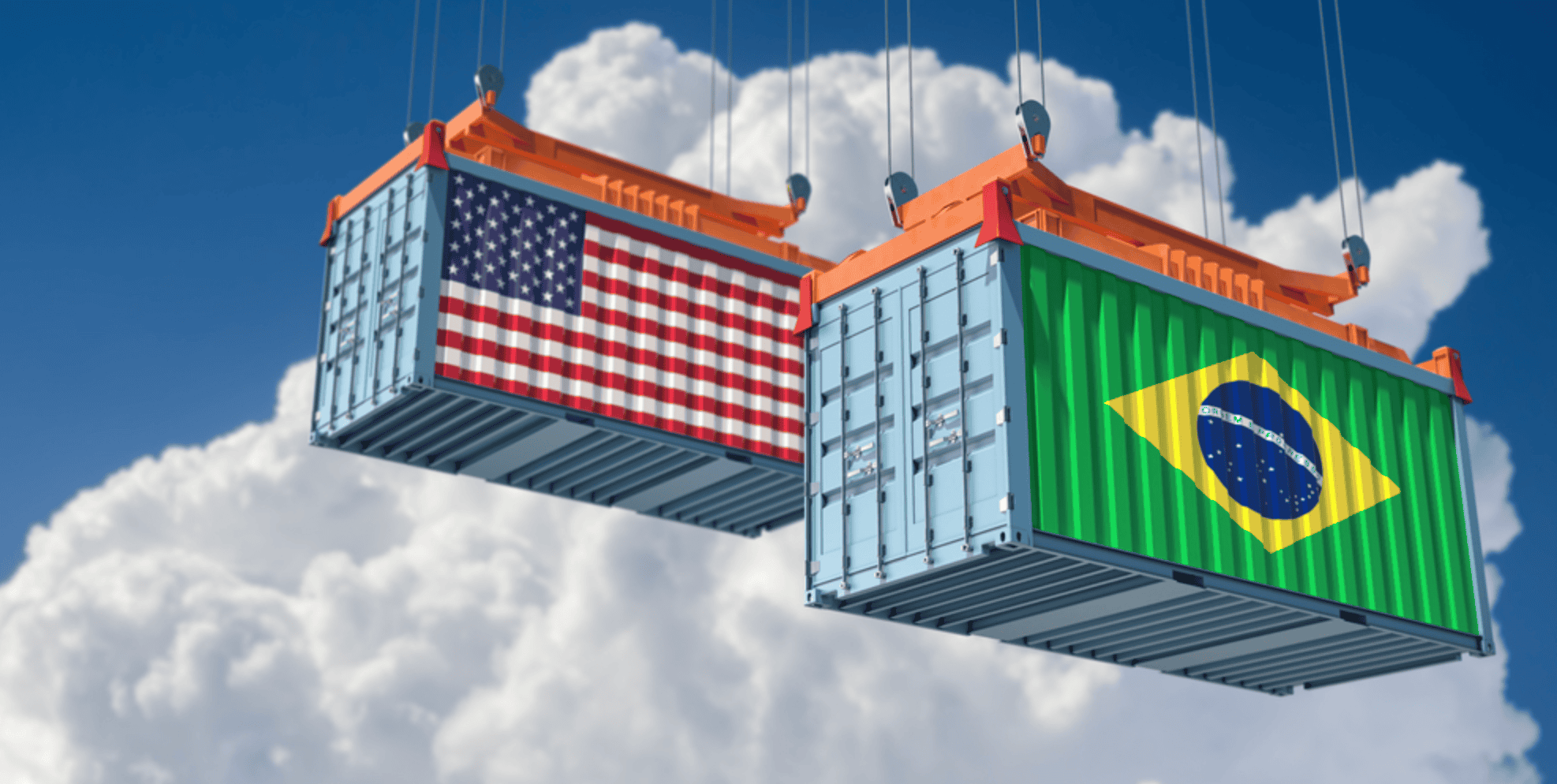
Following the first round of Brazil’s presidential election on October 4th, 2026, Flávio Bolsonaro, son of imprisoned former President Jair Bolsonaro, received 47.03% of the vote, just short of the 50% needed for victory, while incumbent President Lula received 45.16%. The two candidates will face each other in a runoff election on October 25th. Considering the support received by other right-wing candidates, Bolsonaro now has a serious chance of winning the presidency.
What would a Bolsonaro victory mean for the U.S. containerized export market?
As Latin America’s largest economy, Brazil has long been an important trading partner of the U.S. That said, the last few years have been quite challenging for trade between the two countries. With Trump and Lula holding very different political and economic views, trade has increasingly become a source of political and economic pressure, particularly during 2025 and 2026.
Beyond the general protectionist policies of both countries, several specific measures have been introduced.
In 2025, the U.S. imposed 25% Section 232 tariffs on Brazilian steel and aluminum, later increasing them to 50%. This was followed by a 10% additional baseline tariff and a further 40% Brazil-specific tariff on many products, subject to exemptions. In 2026, the U.S. introduced an additional 25% Section 301 tariff on covered Brazilian goods, as well as a separate 12.5% tariff affecting selected products under a broader trade action. Some of the earlier tariffs were subsequently removed or modified.
Meanwhile, Brazil followed a more targeted approach, particularly in the petrochemical sector. In May 2025, Brazil adjusted its existing anti-dumping duty on U.S. PVC resin to 43.7%. In August 2025, it imposed a provisional anti-dumping duty of $199.04 per metric ton on selected U.S. polyethylene grades, while maintaining elevated ordinary import tariffs of 20% on certain resins. In April 2026, the polyethylene anti-dumping duty became definitive for up to five years. Brazil also extended the 20% ordinary import tariff on selected polyethylene and polypropylene grades for another year in August 2026.
What has been the impact on actual freight movements?
According to Datamyne statistics, during the first seven months of 2025, the U.S. exported approximately 250,000 TEUs to Brazil. During the same period in 2026, that number declined to just 186,000 TEUs, representing a 26% reduction.
Even more interesting, polyethylene alone accounted for approximately 54% of the total decline in U.S. containerized exports to Brazil. This is particularly significant considering Brazil’s anti-dumping and import tariff measures affecting U.S. polyethylene.
U.S. imports from Brazil also declined substantially. Comparing January to August 2025 with the same period in 2026, container volumes dropped from approximately 295,000 TEUs to 231,000 TEUs, a decline of nearly 22%.
Wood products recorded the largest absolute decline, losing approximately 14,600 TEUs, or 22%. Paper and paperboard declined by 42.5%, coffee by 32%, and ceramics by 49%. Several other commodity groups also experienced significant reductions.
While tariffs likely contributed to these developments, changes in market demand, commodity prices, sourcing decisions, and other economic factors also need to be considered.
Ocean carriers are also feeling the pressure.
Traditionally, U.S.–Brazil container trade has been supported by direct services connecting major Brazilian ports, including Santos and Rio de Janeiro, with ports along the U.S. East and Gulf Coasts.
When carriers establish direct vessel services between these ports, they depend on sufficient cargo volumes in both directions to maintain commercially viable operations.
With containerized imports declining by approximately 22% and exports by 26%, maintaining these services becomes increasingly challenging.

Throughout 2026, we have seen carriers adjust their networks, omit certain direct port calls, and replace some direct connections with transshipment services. More recently, ZIM and ONE announced the discontinuation of their shared U.S. Gulf–Brazil service.
It is also worth remembering that a substantial portion of U.S. polyethylene exports originates in the Houston area, making the U.S. Gulf particularly sensitive to changes in petrochemical trade flows.
Although carrier network decisions involve multiple commercial factors, declining cargo volumes certainly create additional pressure on service sustainability.
So, what should we expect if Flávio Bolsonaro wins?
My expectation would be an improvement in communication between the two governments, potentially creating a more constructive environment for bilateral trade negotiations.
Bolsonaro has already proposed closer trade integration with the U.S., which could provide a starting point for more structural changes. The two countries have also begun discussing potential trade arrangements, and a Bolsonaro victory could create additional political momentum.
However, there is an important distinction between ordinary tariffs and anti-dumping duties.
While some tariffs could potentially be reduced through negotiations, removing Brazil’s anti-dumping duties on U.S. polyethylene, PVC, and polypropylene would be more complicated.
Braskem, Brazil’s major domestic petrochemical producer, has actively supported stronger protection for local production. These measures are therefore not simply political tools directed against the United States but also reflect domestic industrial interests.
For this reason, I would expect a Bolsonaro administration to prioritize reductions in selected ordinary import tariffs and broader trade agreements before attempting to eliminate existing anti-dumping orders.
This will be the key issue to watch.
Even if Bolsonaro wins and relations between Washington and Brasília improve considerably, that does not necessarily mean Trump will abandon his protectionist trade agenda. Likewise, a more U.S.-friendly Brazilian government may still be reluctant to remove measures protecting its domestic manufacturers.
Overall, I believe a Bolsonaro victory would create a more positive outlook for U.S.–Brazil trade, potentially supporting a recovery in containerized volumes in both directions.
However, the actual recovery will depend on whether both governments can turn improved political relations into meaningful trade agreements, particularly in sectors where domestic industrial protection remains a priority.
The election may change the political relationship quickly. Rebuilding trade volumes, however, could take considerably longer.