




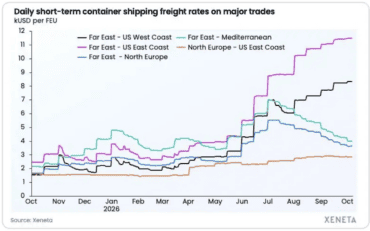
The global container market has entered the fourth quarter of 2026 with one of the most unusual pricing splits in recent memory. Asia to North America spot rates have approached pandemic-era highs, while other East to West routes have declined. Sea-Intelligence’s analysis of Drewry’s World Container Index found that the Asia to U.S. East Coast and Asia to North Europe rate gap reached about $7,000 per FEU in early October, which is more than twice the 2021 record. The chart below illustrates how sharply the transpacific has separated from other major trades.
Europe is entering the final quarter of 2026 under very different market conditions. As carriers increasingly return to Suez Canal routings, additional vessel capacity is re-entering the trade, creating downward pressure on freight rates. That shift is already evident in pricing data. According to Drewry’s World Container Index, rates from Shanghai to Genoa have fallen from approximately $6,400 per FEU in early July to $3,700, while Shanghai to Rotterdam has declined from nearly $5,000 to $3,350. Analysts expect this trend to continue through Q4, as capacity is returning faster than carriers can absorb it through blank sailings.
Congestion is contributing to rate increases
Several factors are driving this split, but congestion is the biggest one. About 12% of the world’s container ship capacity is currently delayed at ports, the highest level in four years. More than 130 vessels are waiting at Shanghai and Ningbo, leaving about 860,000 TEUs stuck in queues.
Typhoon activity has also been unusually intense this season, with several storms affecting coastal China over the past month. Each storm can temporarily close ports, create backlogs at anchorages, and force ships to reroute, adding even more tension to an already strained network across East Asia.
China’s Golden Week is driving pressure on rates
China’s Golden Week holiday added another layer of pressure. As factories restart, carriers are working through vessel bunching, schedule disruptions, typhoon-related port omissions and a series of blank sailings that may continue through October.
The duration of these constraints will depend on the post-holiday rebound. Stronger demand could keep ships full and schedules tight, while weaker demand may allow capacity to normalize later in the month.
The AI boom is pushing demand higher, pressuring rates
The large-scale AI buildout in the United States has been a major driver of import growth and helps explain why transpacific demand stays unusually strong. Semiconductors, data center hardware and transmission equipment accounted for a significant share of 2025 trade expansion.
Without the AI investment boom, U.S. imports would have declined by about 10%, according to the Federal Reserve Bank of Minneapolis. This concentrated demand helps explain continued pressure on transpacific services as other cargo activity slows.
What to expect going forward in Q4 2026
Severe port congestion, concentrated AI-driven demand, and rising geopolitical risks are leaving the transpacific market on uneven ground as it enters the fourth quarter. Recent attacks on tankers in the Strait of Hormuz and Sohar show how quickly conditions can change across global trade lanes.
Schedules will remain vulnerable to external shocks, and capacity is likely to stay tight. Rate stability may also prove difficult to achieve. Shippers who stay proactive, secure space early, and maintain flexible routing and inventory plans will be better prepared to manage the volatility ahead.